Multimodal Communication for Nonspeaking Individuals Public
Multimodal Communication for Nonspeaking Individuals
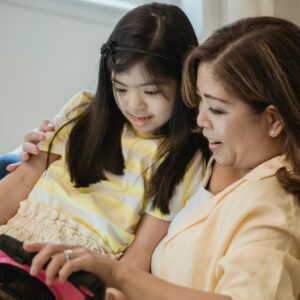
Multimodal communication means using different ways to express thoughts and needs. Some people communicate by typing on keyboards, pointing to letters on boards, or using picture symbols. These different methods help nonspeaking individuals share their ideas with others. Everyone has their own preferred way to communicate, and it’s important to respect these choices. Communication devices can range from simple letter boards to advanced electronic tablets with specialized software. These tools give people who don’t speak a voice to participate in conversations, school, and daily activities.
Keywords:
- Multimodal
- Nonspeaking
- Communication
- Devices
Reasoning Question with Two Choices:
- When someone uses multiple ways to express themselves, are they using unimodal or multimodal communication? (multimodal)
Reasoning Question with a Predictable Answer:
- People who don’t speak with their voices need alternative ways to express their thoughts and __. (Expected completions: needs (65%), ideas (25%), feelings (10%))
Reasoning Question with a Range of Responses:
- A keyboard is a tool for communication. What’s another tool someone might use to communicate?
Open-Ended Question:
- How might having access to different communication methods change someone’s daily experiences?
Text-based communication tools give nonspeaking individuals independence and self-expression. Letter boards allow people to point to letters to spell words and form sentences. Electronic devices with specialized keyboards can speak words aloud when letters or symbols are selected. These tools can be personalized to match each person’s physical abilities, language skills, and communication needs. The most effective approach often combines several methods, allowing individuals to choose the right tool for different situations. With proper support and access to appropriate tools, nonspeaking people can fully participate in education, relationships, and community life.
Keywords:
- Independence
- Letter boards
- Personalized
- Participation
Reasoning Question with Two Choices:
- When communication tools are adapted to match someone’s specific abilities, would this be considered standardized or personalized support? (personalized)
Reasoning Question with a Predictable Answer:
- Text-based communication gives nonspeaking individuals a way to express their thoughts and share their __. (Expected completions: ideas (60%), voices (25%), opinions (15%))
Reasoning Question with a Range of Responses:
- Education is one area where communication tools help nonspeaking people participate. What’s another area of life where these tools would be important?
Open-Ended Question:
- What challenges might someone face when learning to use a new communication system, and how might these challenges be addressed?
SOURCES:
- American Speech-Language-Hearing Association. (2023). Augmentative and Alternative Communication. https://www.asha.org/public/speech/disorders/aac/
- Communication First. (2022). Communication Rights. https://communicationfirst.org/
- Beukelman, D. R., & Mirenda, P. (2013). Augmentative and Alternative Communication: Supporting Children and Adults with Complex Communication Needs. Paul H. Brookes Publishing Co.